Your Baby's Anomaly Scan Found a Problem - Planning Delivery and Care Before Birth

Published 4 Oct 2026 · Updated 9 Oct 2026 · 7 min read

The anomaly scan has shown a problem in your baby, and the next few weeks feel uncertain. Many of these conditions can be treated with surgery after birth, and finding them early gives you time to plan. This guide explains the tests that follow, where to deliver, and why meeting a paediatric surgeon before birth helps.
In this article
What does an "abnormal" anomaly scan mean?
The anomaly scan, usually done at 18–22 weeks, checks your baby's organs one by one. When it shows something unexpected, the report may say "structural anomaly", "congenital anomaly" or name a specific finding. Hearing this is frightening, and it is natural to fear the worst.
Many conditions found on this scan affect a single organ system and can be treated with surgery after birth. These include:
- A food pipe that has not formed completely (esophageal atresia)
- A blocked bowel (duodenal or intestinal atresia)
- A gap in the tummy wall (gastroschisis or exomphalos)
- A hole in the diaphragm (congenital diaphragmatic hernia)
- Lung cysts
- Kidney and bladder problems
Finding a problem before birth is an advantage. It gives you time to confirm the diagnosis, meet the specialists, and choose the right hospital for delivery, so that your baby receives the right care from the first minute of life.

How is it found?
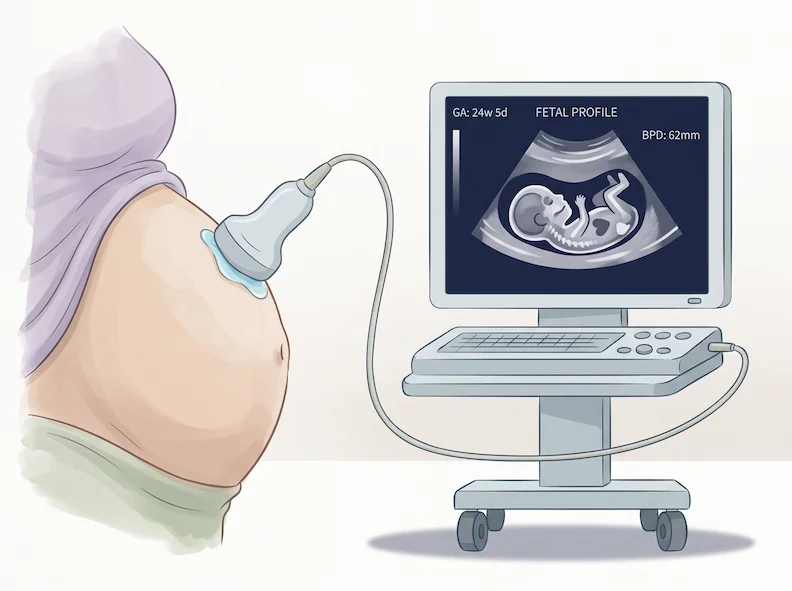
You won't notice these conditions yourself during pregnancy. They are picked up on ultrasound, most often on the anomaly scan at 18–22 weeks. Some become visible only on a later growth scan.
Sometimes the first clue is indirect. Too much fluid around the baby (polyhydramnios) may show that the baby cannot swallow normally, as in a food-pipe or bowel blockage. Too little fluid may point to a kidney or bladder problem.
The first scan report is often only the beginning. A detailed review by a fetal medicine specialist confirms what the finding is, checks for any other associated problems, and helps estimate how the baby is likely to do after birth.
When should you see a paediatric surgeon?
Before your baby is born. Once the finding is confirmed, a consultation with a paediatric surgeon, ideally together with the neonatologist, helps you understand what the condition means, how it is treated, when surgery will be needed, and what the first days and weeks will look like.
This conversation also covers the practical questions: which hospital to deliver in, what to arrange in advance, and how long you may need to stay.
Questions to ask at your antenatal consultation
- What exactly is the condition, and how certain is the diagnosis?
- Are more tests needed during pregnancy?
- Where, when and how should I deliver?
- What will happen in the first hours after birth?
- When will surgery be needed, and how long will my baby stay in hospital?
- Will my baby need follow-up as they grow?
- How will insurance or Ayushman Bharat cover my newborn?
How is it diagnosed?
Depending on the finding, your doctors may suggest:
- A detailed fetal medicine scan to confirm the finding and look for any associated problems.
- Fetal echocardiography to check the baby's heart, because some conditions come with heart differences.
- Fetal MRI, sometimes, for a clearer picture of the lungs, abdomen or brain.
- Genetic tests (amniocentesis or CVS) when a condition is linked with chromosomal differences. For example, a blockage just beyond the stomach (duodenal atresia) is sometimes associated with Down syndrome.
- Repeat scans to follow the baby's growth, the fluid level and the condition itself.
Not every baby needs every test. The aim is to understand your baby's condition well enough to plan the delivery and the first days after birth.
Keep all your scan reports, images and test results together in one folder. Bring them to every consultation, and to the hospital when you go in for delivery.
Treatment and the right time for it
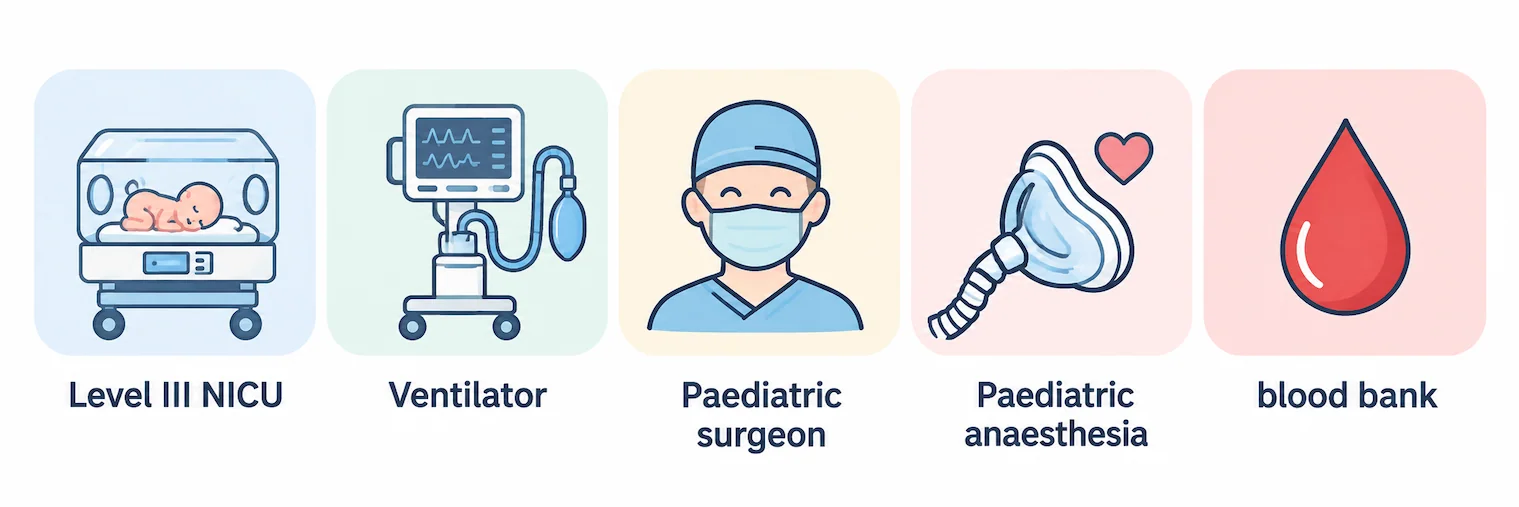
Where to deliver matters most. Babies who need surgery soon after birth should ideally be born in a hospital that has a level III NICU, a paediatric surgeon, paediatric anaesthesia, and a blood bank under one roof. Travelling there while you are still pregnant is far safer than transferring a sick newborn.
Most babies do not need an early delivery or a caesarean. For most of these conditions, the timing and mode of delivery follow your obstetrician's usual advice. A caesarean is advised only in specific situations, such as a very large tumour or sac.
The timing of surgery depends on the condition:
- Within hours: gastroschisis, where the bowel is covered and protected immediately after birth, then placed back inside or supported in a protective bag (silo).
- Within the first days: esophageal atresia and bowel blockages, once the baby has been assessed and stabilised.
- After stabilisation: congenital diaphragmatic hernia. The baby's breathing and circulation are stabilised in the NICU first, and surgery follows when the baby is ready.
- Planned, weeks to months later: many lung cysts and some kidney conditions, when the baby is well at birth.
After birth: NICU, surgery and going home
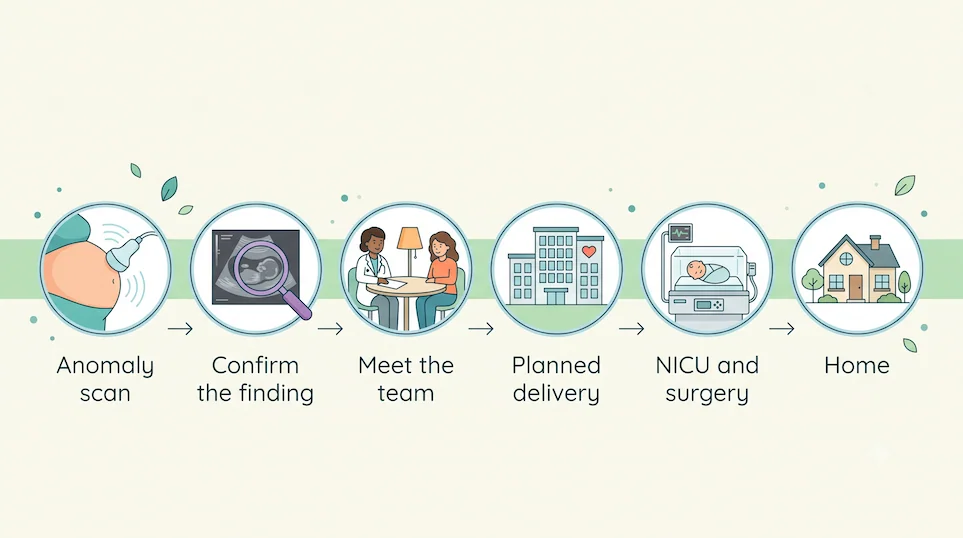
In the first hours, your baby is examined and stabilised in the NICU. Depending on the condition, this may include a fine tube through the nose or mouth to keep the stomach empty, fluids through a drip, breathing support, and tests to confirm the diagnosis.
You remain your baby's parent throughout. Ask the team when you can see, touch and hold your baby. Expressed breast milk is valuable even when your baby cannot feed yet, because it can be stored and used once feeds begin.
After surgery, feeds are started gradually. The hospital stay varies, from about a week for some conditions to several weeks for others. Before discharge, you will be taught how to feed and care for your baby at home, and follow-up visits will be planned.

The bottom line A problem on the anomaly scan is the start of a plan, not the end of hope. Confirm the finding, meet the team before birth, and deliver where your baby's care can begin from the first minute. Book an antenatal consultation with a pediatric surgeon to go through your scan reports and plan your baby's care.
Frequently asked questions
References
- Salomon LJ, et al. ISUOG Practice Guidelines (updated): performance of the routine mid-trimester fetal ultrasound scan. Ultrasound Obstet Gynecol. 2022;59(6):840–856.
- Snoek KG, et al. Standardized postnatal management of infants with congenital diaphragmatic hernia in Europe: the CDH EURO Consortium Consensus, 2015 update. Neonatology. 2016;110(1):66–74.
- Dingemann C, et al. ERNICA consensus conference on the management of patients with oesophageal atresia and tracheoesophageal fistula. Eur J Pediatr Surg. 2020;30(4):326–336.
- Kirollos DW, Abdel-Latif ME. Mode of delivery and outcomes of infants with gastroschisis: a meta-analysis. Arch Dis Child Fetal Neonatal Ed. 2018;103(4):F355–F363.
Have a question about your child?
This article is for general education and does not replace a clinical examination. Every child's condition is different — please consult a qualified paediatric surgeon for advice specific to your child.
Helpful next reads for parents.
Paediatric Urology
"The Scan Shows a Swollen Kidney" - A Parent's Guide to Antenatal Hydronephrosis
Your pregnancy scan report mentions hydronephrosis, pyelectasis or an "APD" measurement, and you're worried about your baby's kidney. This guide explains what the finding means, why most babies do well, and which steps after birth determine whether your baby needs any treatment at all.
Read related guideParent Guide
Is Pediatric Surgery Safe? What Every Parent Should Know
A reassuring guide for parents on why modern pediatric surgery is highly safe, how risks are managed, and how families can support the best outcome.
Read related guidePaediatric Urology
Hypospadias: Why the Opening Is in the Wrong Place, and the Right Age to Repair It
The doctor has noticed that the urine opening on your baby boy’s penis is not at the tip, or that his foreskin looks like a hood. This is hypospadias, one of the most common conditions boys are born with. This guide explains what it is, why circumcision must wait, the right age for surgery, and what recovery involves.
Read related guide